


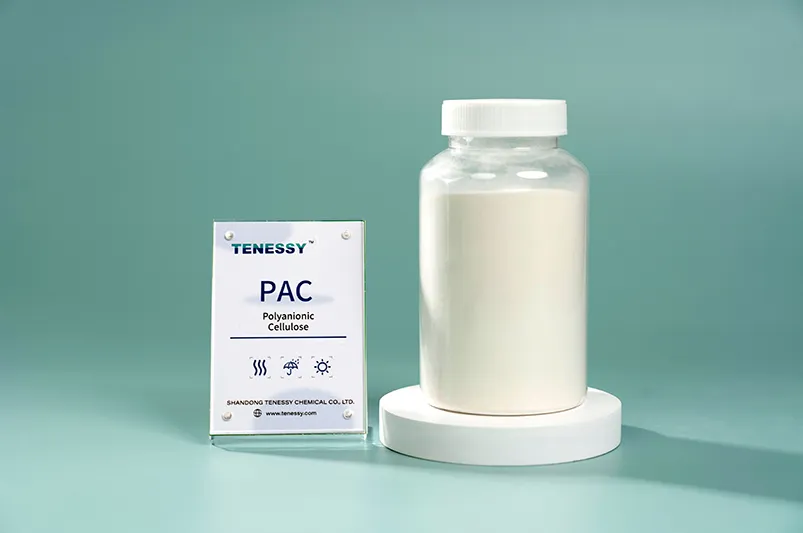
Polyanionic Cellulose, referred to as PAC
- TENESSY
- China
- 15~20 days
- 9004-32-4
 Email
EmailPhysical and chemical properties
Appearance: usually white powder
Substitution degree: It is a high-substitution product with a substitution value between 0.85 and 1.4.
Heat stability: The aqueous solution is stable below 80°C, and can still show a certain viscosity when the temperature is close to 150°C.
Acid, alkali and salt resistance: The pH value is stable in the range of 3-11, and can be used in various polar harsh environments.
Compatibility: It is compatible with other cellulose ethers, water-soluble glues, softeners, resins, etc.
Solubility: It can be dissolved quickly in cold water and hot water with a simple stirring device, and the hot water dissolves faster.
Stability: PAC aqueous solution has light stability and a longer shelf life; it has strong anti-bacterial and mildew resistance and does not ferment.
Dosage: Due to the high degree of substitution and high stability of PAC, its dosage is very small under the same use environment. The general addition amount is about 0.2%-0.6%, which is only about 30-50% of other cellulose ethers (such as CMC, etc.), and has a high cost-effectiveness advantage.
Environmental protection: The main raw material is refined cotton, which has no pharmacological effect, is harmless to the human body, and the production process is green and environmentally friendly.
Recommended application areas
1. Oil drilling fluid: As an efficient fluid loss reducer and viscosity enhancer, it is widely used in freshwater, brine, saturated brine and seawater drilling fluid systems, especially in deep wells, ultra-deep wells, offshore drilling and drilling with high requirements for reservoir protection.
2. Food industry: As a thickener, stabilizer, suspending agent, water retention agent, used in ice cream, dairy products, condiments, sauces, baked goods, beverages, etc.
3. Pharmaceutical industry: As a binder, disintegrant, sustained-release material for tablets, and stabilizer for suspensions.
4. Paint industry: As a thickener and stabilizer for water-based paints, it improves leveling and splash resistance.
5. Daily chemical industry: Used in toothpaste, shampoo, shower gel, cosmetics, etc. as a thickener, stabilizer, suspending agent.
6. Ceramic industry: As a plasticizer and binder for green bodies and glazes.
7. Textile printing and dyeing: As a thickener for sizing agents and printing pastes.
8. Construction industry: used as water retaining agent and thickener in cement mortar and gypsum products to improve construction performance.
9. Others: detergent, papermaking, mining (flotation), pesticides, etc.
Oil drilling field: As an inhibitor and fluid loss reducer, it can inhibit the dispersion and expansion of clay and shale in high-salt media and control well wall pollution. The formulated mud fluid has good water loss reduction, inhibition, and high temperature resistance. It can effectively protect the production layer, has the carrying capacity of clean wellbore, and the ability to resist water and silt infiltration. It rarely foams and can be stored or transferred between wells. It is lower than the cost of general mud repair fluid.
Advantages of PAC in oil drilling
1. Excellent water solubility: It can be quickly dissolved in cold and hot water to form a clear or slightly turbid solution.
2. Efficient thickening: Especially high-viscosity PAC, which can significantly increase the viscosity of aqueous solutions.
3. Excellent fluid loss reduction: This is the core role of PAC in drilling fluid.
* Form a thin, dense, low-permeability filter cake on the well wall.
* Reduce the penetration and loss of water and beneficial components in the drilling fluid into the formation.
* Stabilize the well wall and prevent collapse.
* Good suspension stability:
* Helps to suspend solid particles (such as drill cuttings, weighting materials) to prevent sedimentation.
* Excellent salt resistance: In the presence of high concentrations of salt (such as NaCl, KCl) and even certain high-valent metal ions (such as Ca²⁺, Mg²⁺), its thickening and fluid loss reduction performance is much better than ordinary sodium carboxymethyl cellulose (CMC).
* Certain temperature resistance: The performance is better than CMC and can maintain effective performance at a certain high temperature (usually up to 120°C or more, depending on the salt content and formulation).
* Rheological adjustment: It can affect the rheological properties of drilling fluids (such as plastic viscosity and dynamic shear force).
* Protect reservoirs: The low permeability filter cake formed helps reduce damage to oil and gas reservoirs.
* Good compatibility with other treatment agents: It can be used in combination with a variety of drilling fluid additives.
* Relatively good environmental protection: Compared with some synthetic polymers, its biodegradability is relatively good (although the degradation is slower after modification).
Available Products:
✅ PAC-LV (Low Viscosity)
For filtrate control and thin filter cake with minimal impact on mud viscosity
✅ PAC-HV (High Viscosity)
To increase viscosity and improve cuttings transport in deep or challenging wells
In the ceramic industry, PAC has the characteristics of good uniformity and high degree of substitution. It plays the role of thickening, water retention, bonding, suspension, and dilution on ceramic bodies, glaze slurries, and flower glaze screen printing, and has a very obvious effect on improving the quality of ceramic products, especially the glaze quality of products.
Advantages of PAC in the body
1. Small amount of addition, increase the plasticity of the mud and the flexural strength of the green body
2. Good burning loss, no residue after burning
3. Both suspension and dispersibility, can prevent the aggregation of lean raw material particles
4. Strong resistance to mechanical wear, less molecular chain damage during ball milling and mechanical stirring
Advantages of PAC in glaze slurry
1. Used in tile base glaze and surface glaze, PAC has excellent dispersibility and protective colloid properties, so that the glaze is in a stable dispersion state
2. It can increase the surface tension of the glaze, prevent water from diffusing from the glaze to the body, increase the smoothness of the glaze, avoid cracking and printing fracture during transportation caused by the decrease in body strength after glazing, and reduce the pinhole phenomenon of the glaze after baking.
3. The viscosity of the glaze slurry can be adjusted. PAC makes the glaze slurry have better rheology and is easy to glaze.
4. It can improve the bonding performance of the body and glaze. PAC can improve the strength of the semi-finished glaze and prevent deglazing.
5. The drying time of the glaze layer can be adjusted. Using PAC can obtain a smooth glaze surface and improve the stability of the glaze slurry.
Advantages of PAC in flower glaze
1. Due to the fineness of PAC powder, high purity, strong suspension and dispersion ability, less insoluble matter, high transparency, and excellent acid, alkali and salt resistance, it can effectively reduce the number of screen rubbings, reduce the generation of color difference, and ensure the stability of the printed glaze during storage.
2. PAC has excellent solubility and almost no insoluble matter
3. PAC has good printing rheology and is smooth and free when printing
4. PAC has good screen penetration, which can reduce the number of screen rubbings and has good color consistency.
Existing products:
✅ PAC-LV-H (low viscosity)
✅ PAC-MV-D (high viscosity)
Packaging & Storage
1. Multi layer paper bag with inner PE film
2. Bulk or pallet ,25kg/bag, 500kg or 600kg/ pallet
3. 20' container: 12 Tons, 40' container: 24 Tons (with pallet)
4. Netural or blank bag available, OEM brand available
5. Store in cool, dry, and clean conditions, keep away from heat to aviod spread burning with oxygen.
Safe handing is required to prevent dust with air from reaching explosive levels.
Shelf Life
The shelf life is 2 years. If over 2 years, please test and confirm the quality before using.
Related FAQs
Q: Are you a trading company or manufacturer?
A: We are a factory/manufacturer. Customized production is accepted
Q: Do you provide samples? Is it free or extra?
A: Yes, we could offer 200 g free sample for each grade. Otherwise, we provide free samples, but the freight will be afforded by cleints. Free sample can be offered to ensure our quality.
Q: How to get samples?
A: Please send a sample application, and we will send the samples by express after confirmation.
Q: What is your payment method?
A: We provide a variety of payment methods, and we will provide the best support for long-term partners. T/T, L/C
Q: How about OEM brand and packaging?
A: We provide blank bags, neutral bags, and OEM bags.
Q: How to ensure stable quality?
A: Fully automatic production line, all production processes are carried out in a sealed environment. There is a quality inspection department to conduct quality inspection on the products leaving the factory, and they can only leave the factory after passing the inspection.
PREVIOUS:no more
NEXTVIOUS: no more